Monitor Your Competitors in Real Time: See Every Mention as It Happens
Every time someone complains about a competitor on Reddit, that's a customer you could win. Every time a competitor announces a new feature, that's market intelligence you need. Every time someone asks "any alternatives to ?" on Twitter, that's a lead with intent already formed.
The problem is timing. These conversations happen constantly, across dozens of subreddits and thousands of tweets, and they fade fast. Real-time competitor monitoring means seeing them the moment they happen, not hours later when the thread has moved on. This guide covers what to monitor, how to turn competitor mentions into customers, and how to set it all up in minutes.
Why Real-Time Competitor Monitoring Wins
Competitor monitoring on a delayed schedule, whether daily email alerts or weekly reports, gives you historical data. It tells you what people said about your competitors yesterday. Real-time competitor monitoring tells you what they're saying right now, when the conversation is still open and your response can actually matter.
The window of opportunity is short
A Reddit post asking "has anyone switched away from ?" will get active replies for two to three hours. After that, the thread loses momentum and the opportunity to be part of the conversation is largely gone. Email alerts delivered the next morning mean you're arriving a day late to a conversation that finished the same evening.
Competitor monitoring is also market research
When you track competitor mentions consistently, you're not just looking for unhappy customers to poach. You're building a continuous picture of what your market thinks about the category, what features they want, what pricing feels fair, and what pain points the existing solutions aren't solving. This is market research that would cost thousands through traditional methods.
Speed creates a compounding advantage
The brand that shows up first in competitor-related threads, consistently and helpfully, builds a reputation in relevant communities over time. Early responders get upvotes. Upvotes build community credibility. Community credibility makes future responses land better. The advantage compounds across weeks and months of consistent monitoring.
What to Monitor About Your Competitors
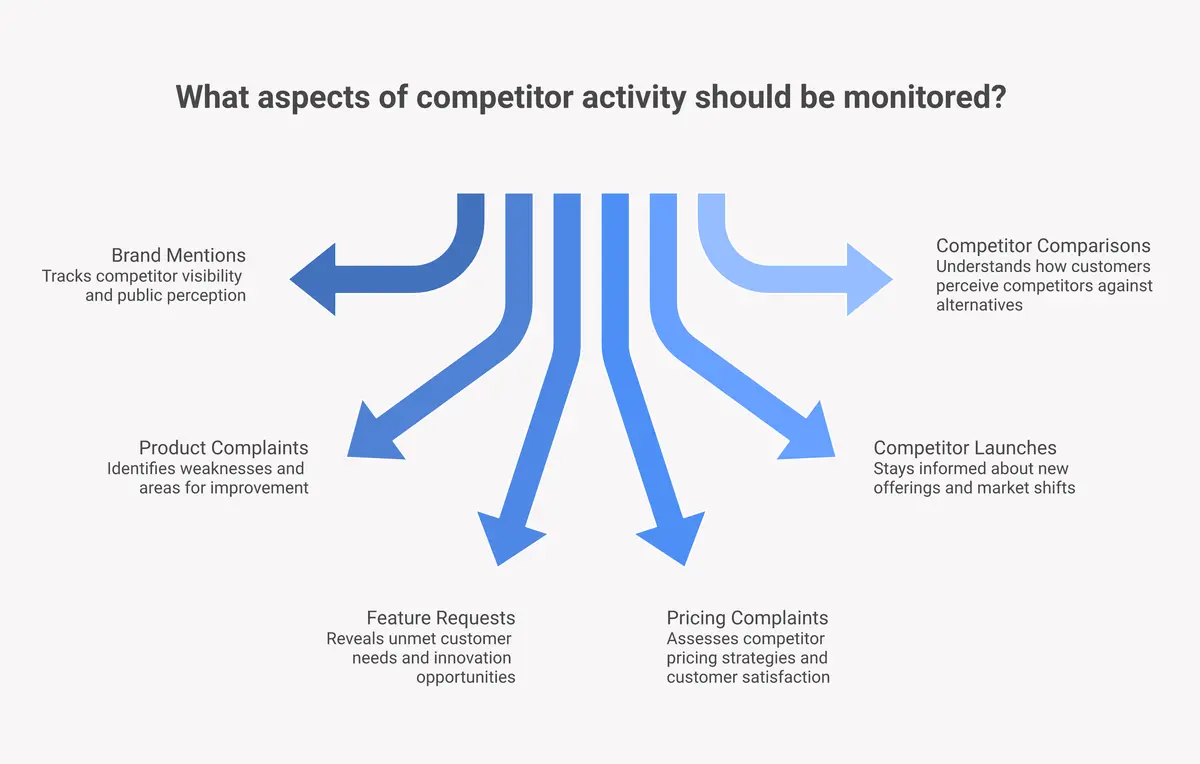
Effective competitor brand monitoring covers more than just your competitor's brand name. A comprehensive monitoring setup watches for several distinct signal types.
Brand name mentions
The obvious starting point: track your competitors by name. Include common abbreviations, misspellings, and product names they're known by. When someone mentions a competitor by name, there's almost always context worth knowing.
Product complaints and frustrations
Posts like "frustrated with 's pricing," "anyone else finding slow lately," or "missing feature in " are high-value signals. These people are not happy. They're describing a pain point that could be solved by switching. If your product addresses what they're frustrated about, this is a conversation worth entering.
Switching and alternative signals
Track competitor names combined with phrases like "alternatives," "switching from," "moving away from," "replacing," and "better than." Someone actively looking for an alternative has already decided to leave. The question is just where they'll go.
Pricing complaints
When people post that a competitor is too expensive or that pricing changed, that's a direct opening. If your pricing is lower or your model is more transparent, you have a genuine answer to what they're describing. This is one of the clearest forms of competitor monitoring that converts into customers.
How to Win Unhappy Competitor Customers
The phrase "steal unhappy customers" sounds aggressive. The reality is much simpler: when someone publicly describes a problem with a competitor's product, and your product solves that problem, the most helpful thing you can do is tell them about it.
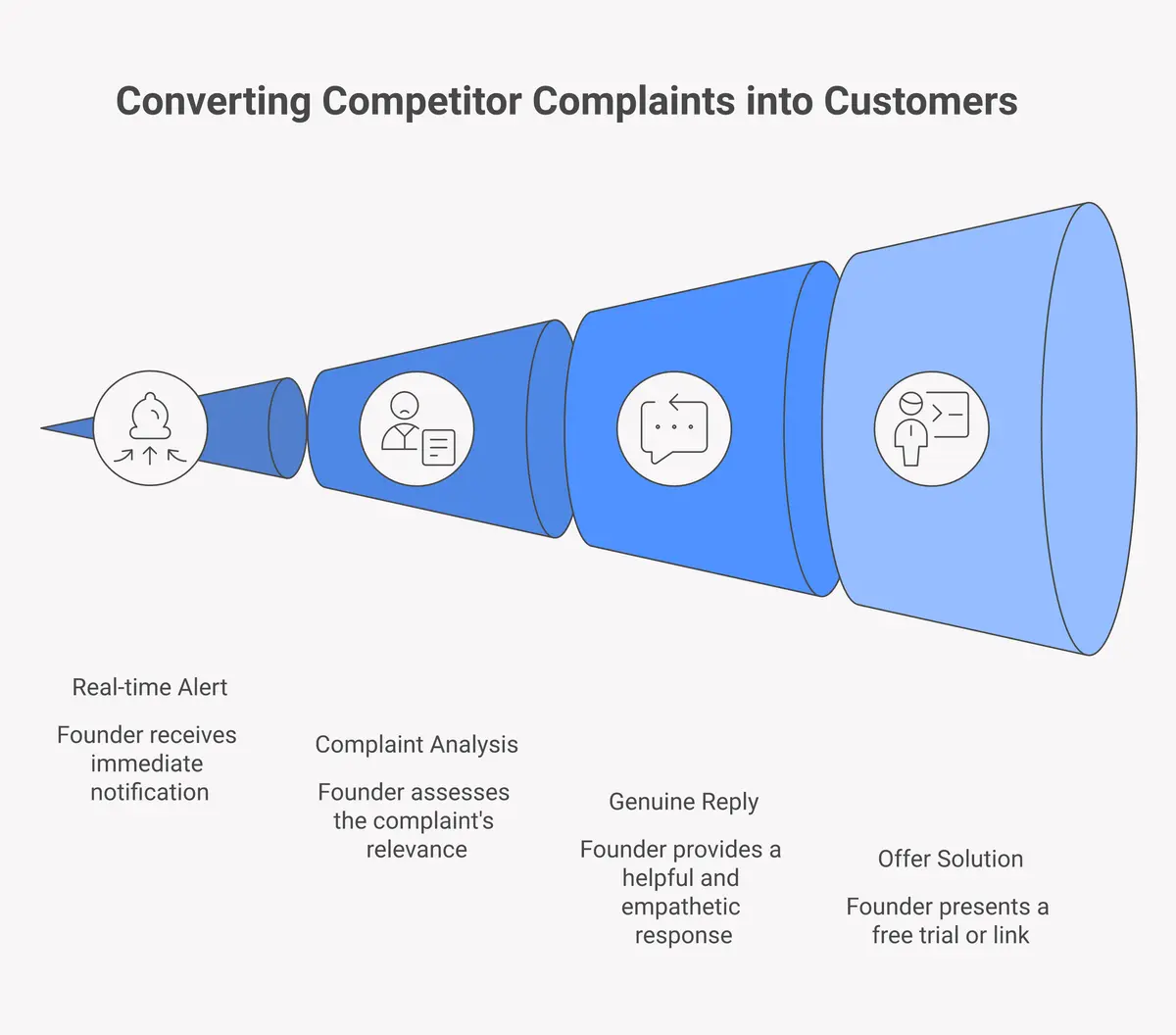
Here's how the process works in practice. Someone posts on Reddit saying "Brand24 is way too expensive for what we need, looking for something simpler." Founderalerts shows you that post the moment it's published. You read it, confirm your product actually addresses what they need, and reply with a genuine response: acknowledge the pricing pain, explain what Founderalerts offers differently, and point them to a free trial.
The key distinction between helpful engagement and spam is relevance. You're not blasting your product link at every mention of every competitor. You're responding to posts where someone described a specific problem that your product genuinely solves. That's not spam. That's being useful at exactly the right moment.
What a good response looks like
Don't lead with your product. Lead with empathy for their situation. "Yeah, 's pricing is a common frustration for smaller teams. What specifically were you looking for?" Then, once you understand their actual need, offer a relevant suggestion that includes Founderalerts if it's the right fit. This approach converts better and doesn't get downvoted.
What to avoid
Don't reply to every competitor mention with the same template. Don't post your product link without context. Don't pretend to be a neutral third party when you're not. Reddit communities recognize these patterns quickly, and getting flagged as a spam account is worse for your brand than saying nothing.
Track Competitor Launches and Announcements
When a competitor releases a new feature, changes pricing, or launches a new product, Reddit and Twitter are where users react first. Press releases come later. Community reactions come immediately.
Why community reactions matter more than press releases
A competitor's press release says what they want you to hear. Reddit and Twitter posts from their actual users tell you what people actually think. When a competitor raises prices, their blog post frames it as a premium positioning upgrade. Reddit users tell you whether existing customers are upset enough to switch.
Turning launch intelligence into positioning
When you track competitor announcements in real time, you can adjust your messaging quickly. If a competitor launches a feature you already have, you can respond in relevant conversations with accurate information before the competitor's narrative fully sets. If they launch something genuinely new, you have early signal to factor into your roadmap and positioning.
Monitoring for brand crises
Sometimes competitors have public problems: outages, data issues, pricing scandals, or bad press. These are moments when their unhappy users are actively looking for alternatives. Real-time monitoring means you see these conversations as they develop, not after the wave has passed.
Monitor Competitors on Reddit and Twitter
Competitor conversations happen across both platforms but with different characteristics. Twitter competitor mentions tend to be short, reactive, and fast-moving. Reddit competitor discussions tend to be longer, more detailed, and include more context about why someone is frustrated or considering alternatives.
Founderalerts monitors both platforms in a single live wall. When you add a competitor name as a keyword, you see every matching post from Reddit and Twitter together, without switching between tools or tabs. This gives you the complete picture of what people are saying about your competitors across the two platforms where most software-related conversations happen.
For a full breakdown of how Reddit monitoring works in practice, including how to set up subreddit-specific tracking for competitor names, see the Reddit monitoring guide.
Competitor Monitoring vs Google Alerts
Google Alerts is the default tool most people use for competitor monitoring. It's free and easy to set up. It's also fundamentally slow: Google Alerts sends you an email after Google indexes a page, which can take hours or longer for Reddit posts and tweets.
For a platform like Reddit, where threads peak in two to three hours, Google Alerts typically arrives after the conversation is over. For Twitter, the delay is less predictable but still measured in hours. By the time the email arrives, the post has been replied to, upvoted, and in many cases resolved.
Founderalerts monitors Reddit and Twitter directly. There's no indexing delay. When someone posts a competitor complaint, you see it within seconds of publication. That's the difference between competitor monitoring that's reactive (Google Alerts) and competitor monitoring that's actually useful in real time.
Set Up Competitor Monitoring in 2 Minutes
Getting your competitor monitoring live with Founderalerts takes less time than setting up a Google Alert. Here's how:
- Start your free trial. No credit card required. Your account is active immediately.
- Enter competitor keywords. Add each competitor's brand name, product name, and common variations. Include switching-signal phrases like " alternative" and " pricing."
- Open the live wall. Monitoring starts immediately. Every matching Reddit post and tweet appears in real time as it's published.
- Enable sound alerts. For high-priority competitor names, sound alerts let you catch posts within seconds of them going live, even when you're working in another window.
- Engage with genuine responses. When a competitor complaint appears, read the full context, then reply with a helpful answer that addresses the specific frustration they described.
Start your free trial today and begin monitoring your competitors in real time. The next post asking "any alternatives to ?" could appear in the next five minutes. The question is whether you'll see it in time.
Frequently Asked Questions
What is competitor monitoring and why does it matter?
Competitor monitoring is the practice of tracking when and where your competitors are mentioned online. It matters because competitor mentions often include unhappy customers, switching signals, and product feedback that represent direct acquisition opportunities. Real-time competitor monitoring captures these moments while they're still active.
How is Founderalerts different from tools like Brand24 for competitor monitoring?
Brand24 is an enterprise social listening tool priced for teams with larger budgets. It monitors Reddit through scheduled polling, not in real time. Founderalerts is built for founders and small teams who need live competitor monitoring across Reddit and Twitter without the enterprise price tag.
Can I monitor multiple competitors at once?
Yes. You can add as many competitor keywords as your plan supports and monitor all of them simultaneously on the same live wall. All competitor mentions appear in one feed, organized by recency, so you can track multiple competitors without managing separate monitoring setups.
Is it ethical to monitor competitors and approach their unhappy customers?
Yes, when done correctly. If someone posts publicly that they're frustrated with a competitor and looking for alternatives, responding with accurate, helpful information about your product is a legitimate business practice. The key is responding genuinely, not manipulatively, and only when your product actually addresses what they described.
What's the difference between competitor monitoring and spying on competitor social media?
Competitor monitoring refers to tracking public mentions and conversations. Tracking competitor activity online through their public social accounts, community posts, and press releases is standard business intelligence practice. Accessing private or non-public information would be a different matter entirely. Founderalerts monitors only public Reddit and Twitter content.